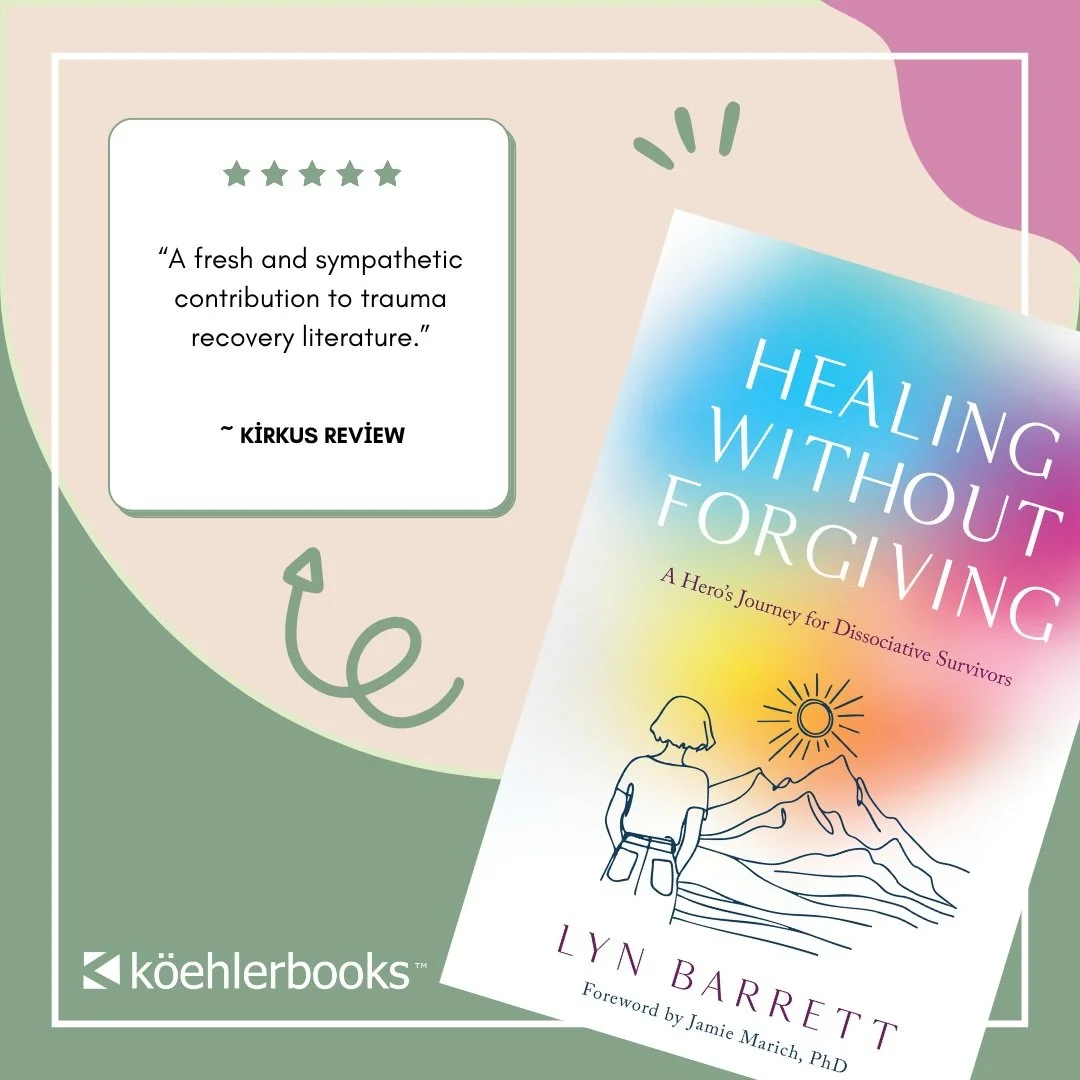
Healing Without Forgiving: A Hero’s Journey for Dissociative Survivors will be published on January 13, 2026 and pre-orders are now open! To give you a sneak preview, I’m printing occasional excerpts from the workbook. Today’s excerpts come from Chapter 5: The Threshold under the subheading Trusting Someone. It starts by emphasizing how important it is to find a therapist you can rely on, who can role model good self-parenting, and who will teach you the healthy responses you never learned as a child.
➰➰➰
When small children, who have no resources of their own, rely on their parents, caregiver, or other adults for food, clothing, shelter, and love, and these same people abuse them, they’re put in a confusing and volatile situation. Should I stay close to this person I need for all aspects of my survival? the child asks unconsciously. Should I run away from the person who hurts me? What should I do if the person I need and the person who hurts me are the same? Come close, run away, come close, run away. Love, hate, trust, fear, love, hate, trust, fear.
What a tragic predicament. Many small children develop attachment disorders from these contradictions. They spin back and forth between options leading nowhere, like a mouse running endlessly on a wheel. Like us, some fragment their minds into dissociative parts in order to survive what might otherwise be unsurvivable. As children, these parts are creative ways to endure a chaotic world where no one eases the pain or helps them process the trauma. As adults, they allow survivors to function in the real world while memory is tucked away in parts created for that purpose. These small children may grow into adults who have difficulty with intimate relationships. Functioning in the adult world, with the hidden history of an abused child revealed as fragments, can upend the brightest, most creative person. The long tail of trauma follows the child into every aspect of their adult life.
Is it any wonder, then, that the first baby step in healing—to trust someone—is perhaps the hardest task for adult survivors of chronic childhood trauma? Someone who will listen, who will believe, who will tell the truth? Someone who won’t run away, who won’t manipulate, who is a constant presence when childhood was a constant terror?
If you’re lucky, you’ve already found a therapist who fits that bill and provides you with a safe space and soft landing that enables you to slowly develop the skills that you missed growing up in a traumatic environment. If you’re not so lucky, you may have found that trusting a therapist isn’t easy and finding the right one takes a long time.
Jumping from therapist to therapist is not uncommon. Sometimes it’s for good reason, because there are some who don’t understand trauma and do more harm than good. On the other hand, attachment issues, complicated by fragmentation, may prompt you to run away when you get too close to a therapist who’s ready to be there for you.
If you find yourself moving from one therapist to another, it’s worth examining the underlying reason. Can you speak to them honestly about your trust issues? How do they respond? Are they willing to slow down as you learn to trust? Have other clients found them trustworthy? The answers to these questions can help you determine if you need to walk out the door, or if it’s worth taking the time to cultivate this new thing called intimacy.
I began to know something was wrong when my family—a husband and four children under ten—began to split apart at the seams. What I didn’t understand at the time was that I had alters taking charge with different capacities to parent and partner. My entry into therapy was driven by my failure in relationships but quickly grew into a whole myriad of issues such as suicidal ideation, body memory, and identity confusion. It took me quite a while to find the right therapist, but when I did, I grew by leaps and bounds. I dedicated my memoir to my therapist, who, I said, “helped me give birth to myself.”
Learning how to trust a reliable therapist is critical. Trusting friends and support communities who allow you to be yourself and connect with others around shared experiences is also important. The writing group I founded that I mentioned in the beginning of this workbook grew into Dissociative Writers. I thought I was building a platform for my memoir. What I didn’t expect was the organic way this group grew and diversified. When women and men came together to share their writing in a structured yet friendly group, they learned to trust themselves and each other. In a safe environment, people shared their vulnerabilities and bonded around common experience.
Today, this group has expanded to include people from all backgrounds with all levels of writing abilities from all over the world. Most importantly, we share our stories with other people who believe us. As we do this together, we are creating new pathways in our brain that help heal the damage we experienced. I discovered that my memoir, while important, was not the main event. The main event was and is the gathering of writers who trust each other!
Finding a therapist and other people you can trust is an important step in the healing journey.
📫 Do you have a therapist you trust? If so, how has that person helped you in your healing journey? If you haven’t found the right person, what are the obstacles you’re running into? Send me your experience, and I’ll share it with others in our next newsletter.
PRE-ORDERS ARE NOW OPEN ON AMAZON AND BARNES & NOBLE !
🕊️
Trust is the glue of life.
It's the most essential ingredient in effective communication.
It's the foundational principle that holds all relationships.
~ Stephen Covey
Lyn