Two Steps Forward, NYTimes
As most of us know, growth is slow and happens in increments. Sometimes we take two steps forward and one step back. This is true for our healing, for our relationships, and for our life goals. Hopefully, and with hard work, we are still moving forward.
It’s also true for the way the public perceives the world, including childhood trauma and how the body responds.

The newspaper took two steps forward with a recent article it published.
In 2022, the New York Times published an article called The Forgotten Lessons of the Recovered Memory Movement by Ethan Watters, a journalist who focuses on “psychiatry and social psychology” according to the Times bio. It was a devastating article for our community because it focused on the debunked false memory syndrome movement and ignored the last 30 years of research into brain and trauma science.
In response, I wrote a blog post that included the thoughts and feelings of members of Dissociative Writers, as well as the few comments from Times readers who threw shade on the article. Sadly but not surprisingly, most commenters welcomed the article and agreed with its tenets. Seems that people STILL don’t want to think about child abuse and will support anything that helps them deny it. It’s easier to cast blame on the victim than to hold the perpetrator accountable. This felt like a huge step backwards.
Today, I wonder what went on in the back rooms of the Times after the article was published. Surely they received letters from people more qualified than I that held their feet to the fire (although I sent them two letters that were never published). Whatever, a Times reporter showed up at the Healing Together Conference in 2024, and several weeks ago (2 years after her visit and 3 1/2 years after the original article) the Times published What It’s Like to Live With One of Psychiatry’s Most Misunderstood Diagnosis by Maggie Jones.
Jones, who interviewed two dozen people living with DID and 20 experts according to the Times bio, offered a balanced, well-researched, and nuanced picture of what it’s like to live with multiple selves. Using the story of Milissa Kaufman as her entry point, she unpacked — as much as could be expected in a brief article — dissociation, DID, brain research, professional and personal disclosure, social media hype, controversy, the Healing Together Conference, and more.
Kaufman, a psychiatrist and trauma researcher, struggled to disclose, and for many years she withheld her diagnosis from her research team. Shame around the diagnosis and the potential impact on her professional research were among many reasons for her hesitation. Jones’s article served as a vehicle for her “coming out”, which she did in the hopes it might help others. “My goal is to help people understand what it’s like as a kid who lives with these symptoms, what it’s like as an adult. It’s not what many people imagine.”
Not everyone is without reservation about Jones’s article, though. Jamie Marich, author and EMDR trainer, noted in a Substack post that the article “gave the primary microphone to more academic voices” and said “we need these scientists and these researchers. I applaud their work. I cite their work, and their minds are valuable in fighting the skeptics of the world.” Still, Marich, who coined the phrase “dissociation is not a dirty word” wants to reclaim dissociation from the shadow of shame. “As I look back on the phrase Dissociation is Not A Dirty Word with some perspective, I not only stand by it, I celebrate it. After years of taking on other people’s shame, the pride approach has helped me to heal more deeply than I ever thought possible.”
Conversations like this are healthy for our community. We are all different and learn from each other. Whether we are comfortable with disclosing or not, our healing path rests, in part, on accurate information in the public sphere. The therapeutic modalities we choose rest, in part, on what’s available in our locales. Our healing intentions are set, in part, on who we are as individuals and our many selves. I encourage you to read the linked articles above; they will give you a broader understanding of how society looks at chronic childhood trauma. Growth is slow, and it happens in increments. That’s the way it works.
With this article, the New York Times took two steps forward. No doubt, they, and we, will take many more steps forward and backward before it’s done. The hope, of course, is that you and I become whole, that people do not look away from childhood trauma, and that someday children and adults are no longer mistreated and abused. Your story and my story, disclosures like Milissa Kaufman’s, and articles like Maggie Jones’s and Jamie Marich’s are a part of the scaffold to a safe world. With hard work and hope, we’re moving forward, one step at a time.
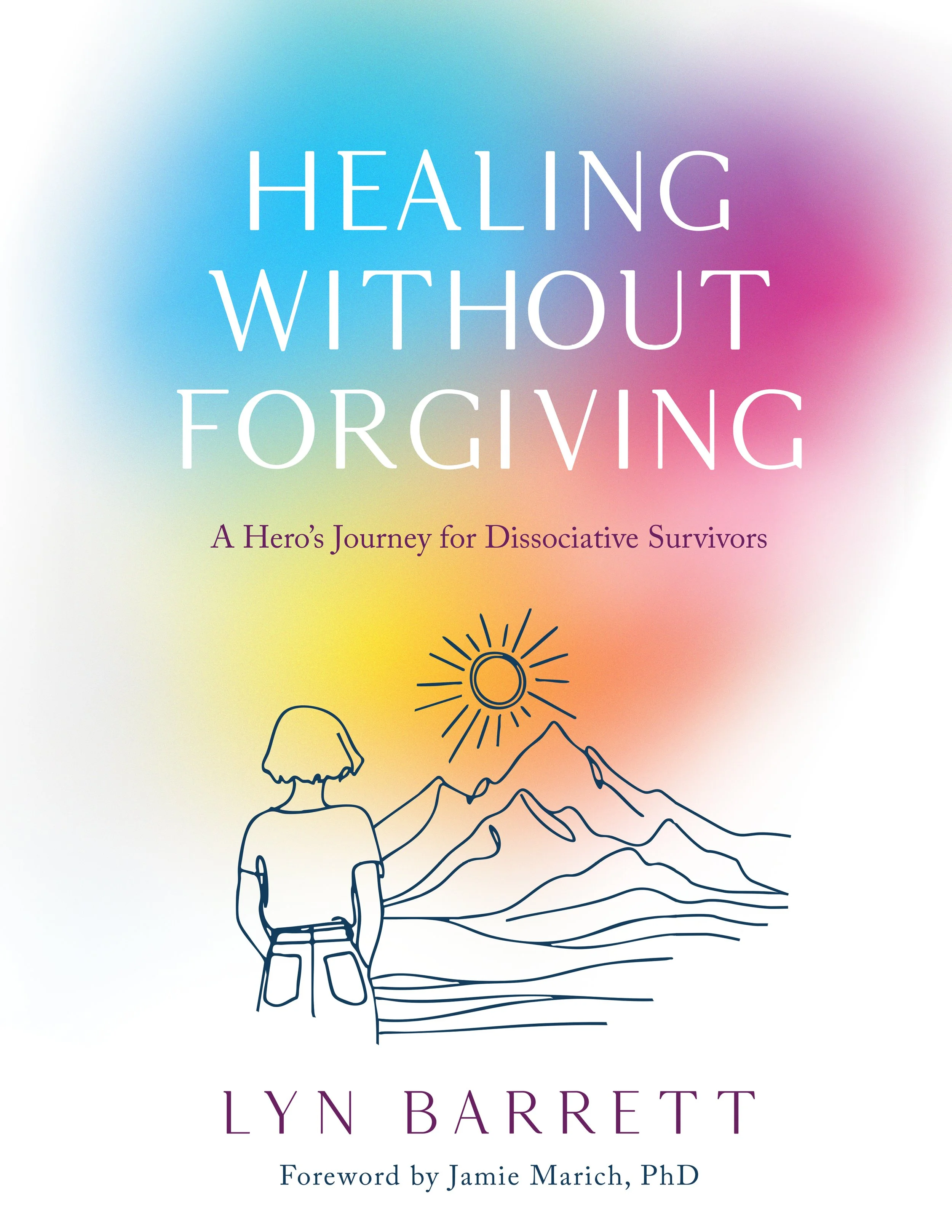
Available now!
A workbook filled with multi-sensory exercises, illustrations, stories of real people, and more. Purchase from Amazon or Barnes & Noble online.
📫 I love to hear your responses to my blog posts. This month, I invite to share your thoughts about the articles linked above by the authors Watters, Barrett, Jones, and Marich. After you’ve read one or all of them, tell me about the thoughts and feelings they bring up. With your permission, I’ll share them in my next blog post. ~ Lyn
🕊️
While dissociation, or specifically the traumatic roots of it, can cause problems in daily living or in societal systems—problems that need to be addressed—dissociation is the skill that has allowed so many of us to survive and, in many ways, to thrive.
~ Jamie Marich
Lyn